A place you can ask
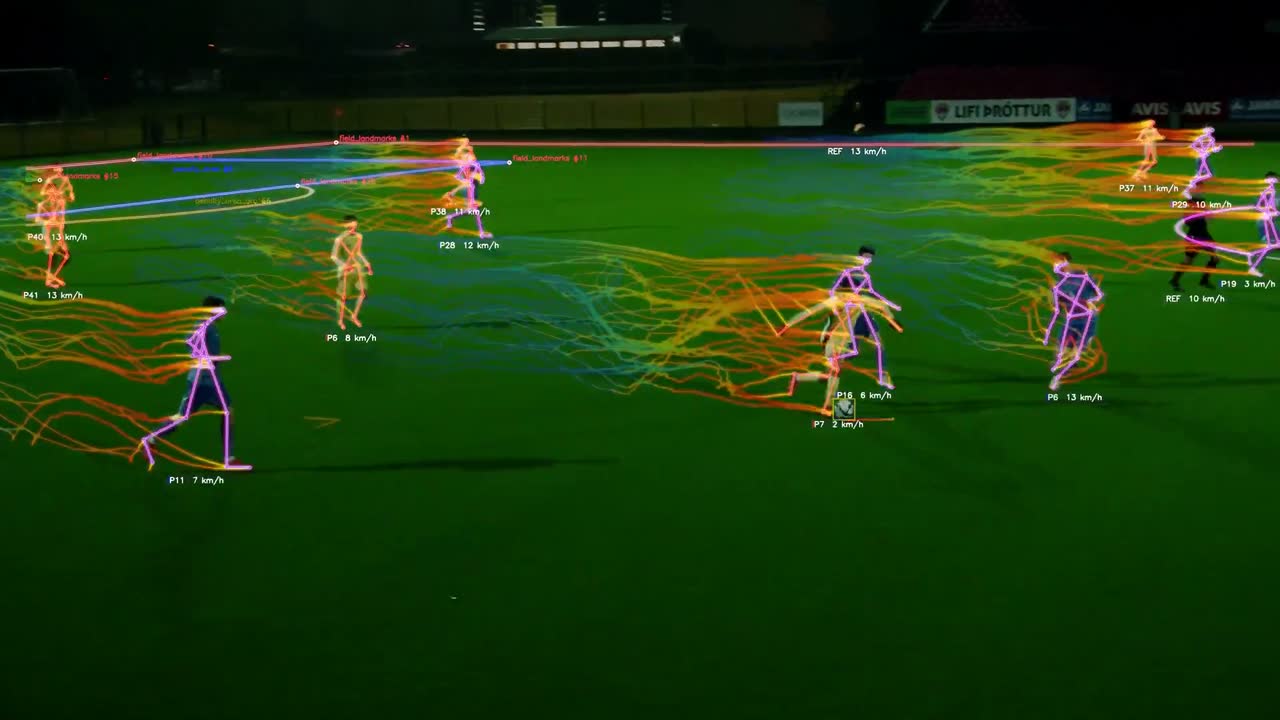
A match is 20 minutes old, and a striker breaks down the left. Somewhere in the stadium, a piece of software asks a question it has already asked many times tonight: where is everyone, right now?
The answer comes back while the run is still on. Every player, the officials and the ball: where each one is, and how fast it's moving.
That's what we mean when we call a place queryable. Our first post was about why physical AI needs it. The second was about the first software that asks. This one is about the asking itself.
What a stadium knows#
A video frame is a picture. Someone has to look at it before it means anything.
The live model of a match holds what that someone would have seen. Every player and official is found, and so is the ball. Each one has a position on the pitch itself, in metres, and a speed. The model is updated many times a second, so its answer is always about now.
Cameras record what a place looks like. OZ understands what's happening in it, and software can read the answer.
Two ways to ask#
The first way is a snapshot. Software asks for the state of the match and gets everything the model holds at that moment: one question, one answer. A tool that needs the whole picture now and then asks this way.
The second way is to follow along. Software subscribes once, and each change arrives as the model makes it; nothing has to ask twice. A robotic camera follows along, because it can't afford to miss a step.
Both answers come from the same live model, running inside the venue.
Who asks today#
Today, every question comes from our own software in the venue.
- The cameras ask where the play is, and turn and zoom to get there.
- The playbook reads the moment, an attack down the left or a scramble in the goalmouth, and sets the shot each camera should hold.
- Our operators see what the model sees, drawn over each camera's picture.
There's one more asker, and it never sees a real match.
The simulator asks too#
Our simulator renders matches with exact ground truth. It knows where every player really was, at every moment. So it asks the model a question it can already answer, and compares the two answers.
That's how we grade a model before it reaches a real venue. A place you can ask is also a place you can check. Then the real venues show us where the simulation is wrong, and we fix it.
A late answer is a wrong answer#
A question about a moving place can fail in two ways. The answer can be wrong. Or it can be right and late: the player was there, but isn't any more.
That's why the model runs inside the venue, on our own chain of small, fast models. Each of them answers in tens of milliseconds. Sending the video to the cloud would add a round trip on top, and the answer would describe a moment that's already gone.
Who asks next#
AI agents already do real work online. They book, buy, write and code. The agent on your laptop can search the whole internet in seconds, but it can't ask the physical world what's happening right now. In a real place, it's blind.
That's what we're building toward. Picture the agent you already use asking a stadium, a port or a street what's happening, and acting on the answer. It would ask the questions our own software asks today, and the place would answer the same way.
Today, the asking stays inside our own software. Opening it to the software of others is the work ahead.
One place you can ask, then the next#
The internet became something you can ask, and everything we built on top of it followed. Search, maps and booking came first; the agents came later, and they're built on the same answers.
A real place can work the same way. A football stadium already does: our software asks it what's happening, many times a second, during a match. The other places where things move come next, each with its own playbook.
That's what making the real world queryable means. One place you can ask, then the next.